
The Hidden Risks of Dependence on People and Technology
Have we surrendered more control than we realise?
Last week, two seemingly unrelated events brought ordinary lives and businesses to a standstill.
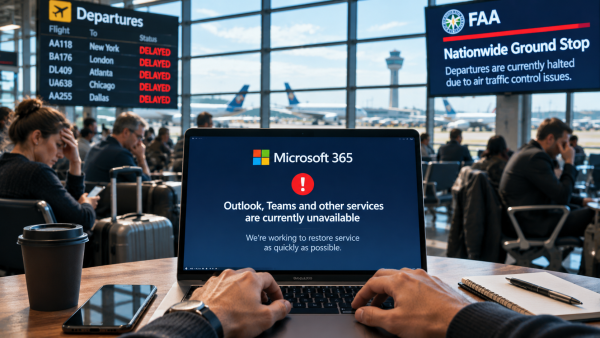
On 12 November, a major Microsoft outage disrupted Outlook, Teams and other services used by businesses, governments and institutions around the world.
The disruption lasted more than 24 hours, affecting communication, meetings and access to essential information.
More than 430 million people use Microsoft 365 applications globally.
While the number directly affected by the outage remains unconfirmed, that figure illustrates the scale of our collective reliance on a single technology provider.
The following day, instability in America’s air traffic control infrastructure prompted the Federal Aviation Administration (FAA) to halt departures nationwide for almost five hours.
Thousands of flights were disrupted, with more than 1.5 million passengers scheduled to depart US airports that afternoon and evening.
The two incidents were unrelated, but their consequences revealed something remarkably similar.
Businesses had entrusted essential communication to infrastructure operated by someone else.
Travellers had entrusted their ability to reach their destinations to an aviation system over which they had no influence.
In both cases, people had made perfectly reasonable plans, only to discover that their ability to carry them out depended on something entirely outside their control.
We have surrendered an extraordinary amount of control in exchange for convenience, efficiency and access to systems we could never have built ourselves.
And most of the time, we barely notice.
The Bargain We Have Made
Think about what these systems allow us to do.
A small business in Stellenbosch can communicate with customers in London, collaborate with colleagues in New York and manage its operations across continents without owning a single server.
An entrepreneur can build an international business with little more than a laptop, an internet connection and a handful of subscriptions.
Similarly, we can board an aircraft in Cape Town and arrive on the other side of the world, relying on a vast network of infrastructure, technology and people.
We don’t need to understand how it all works. We simply expect it to.
And why shouldn’t we?
These systems have made our lives easier, our businesses more efficient and opportunities accessible that previous generations could scarcely have imagined.
But there is an important distinction.
We pay for these services, organise our businesses around them and become increasingly sophisticated in how we use them. Eventually, they feel like part of our own organisations.
But they aren’t.
We have access to them. We don’t control them.
And those are two very different things.
There is also something peculiar about a service that works almost all the time.
Eventually, we stop considering the possibility that it might not.
We don’t begin each morning wondering whether our emails will work or whether the banking system will process our payments. Reliability has earned our confidence, and that confidence gradually becomes an assumption.
Perhaps that is how some of our most important vulnerabilities develop.
Not because we have been careless, but because something has worked so well for so long that we no longer question our dependence upon it.
Until it stops working.
Surely We Should Have a Backup?
Whenever a major disruption occurs, the advice arrives almost immediately.
Businesses should have contingency plans, diversify their suppliers, build redundancy and prepare for the unexpected.
All perfectly reasonable.
But how realistic is it?
Should a small business maintain two entirely separate communication systems in case Microsoft fails?
Perhaps. But what if both depend on the same internet connection, devices or underlying infrastructure?
Should we duplicate every critical process, employ additional people and pay for alternatives we might never use?
And where does it stop?
Consider the aviation disruption. What exactly should an entrepreneur have done to protect themselves against a nationwide air traffic shutdown?
Book another airline? Arrange alternative flights? Avoid travelling altogether?
None necessarily addresses the underlying problem.
We could spend enormous amounts of money preparing for events that may never happen, only to be caught by something nobody anticipated. Attempting to become entirely independent would also mean sacrificing many of the efficiencies that made these systems attractive in the first place.
This is what makes the question so difficult.
Dependence is not necessarily the consequence of poor judgment. Often it is the result of perfectly sensible decisions.
Perhaps the more difficult question is not how we eliminate dependence, but how consciously we choose it.
When Responsibility Exceeds Control
Most founders understand that their businesses depend on other people and organisations.
Customers, suppliers, banks, employees and technology providers all play their part.
But knowing that a dependency exists is not necessarily the same as understanding what it means.
A business might know that most of its revenue comes from three customers.
It’s a number in a management report until one customer leaves.
Suddenly, the implications extend far beyond revenue, affecting salaries, cash flow, confidence and perhaps even the founder’s personal financial security.
The same applies to the supplier who has never let us down, the employee who holds years of irreplaceable knowledge, or the platform through which every customer transaction passes.
We understand their importance, but do we fully appreciate how much rests on their continued availability?
And even when we recognise the exposure, what can we realistically do about it?
This is where the challenge of leadership becomes more apparent.
Perhaps mature leadership is not about eliminating uncertainty, but recognising how much uncertainty we have accepted without noticing.
Founders spend years developing the ability to influence outcomes.
They solve problems, negotiate, build relationships and make difficult decisions. Those abilities are often central to their success.
Yet they can also create an expectation that almost everything should be manageable if we work hard enough.
Sometimes it isn’t.
In conversations with founders and executives, I am often struck by how much energy can be devoted to trying to manage things that are not entirely manageable.
Not because people lack ability, but because they are exceptionally capable and have become accustomed to finding solutions.
There is something uncomfortable about accepting responsibility for an outcome without controlling everything that determines it.
And yet that is precisely what leadership often requires.
It may mean understanding which dependencies are genuinely critical, questioning assumptions about reliability and accepting that certain disruptions simply cannot be planned away.
Sometimes the conclusion will be that the dependence is entirely reasonable.
The benefits outweigh the risks, or the alternatives are too expensive, complicated or limiting.
At least we have made the choice with our eyes open.
The Dependencies We Don’t Always Recognise
But there is another dimension to this dependence, one that reaches beyond our businesses.
We have been talking about systems and organisations, but the same gradual shift can happen in our personal lives.
We come to rely on familiar relationships, the opinions of people we respect, and circumstances that make us feel secure.
None of this is necessarily unhealthy. In fact, much of it enriches our lives.
Yet something that initially gives us confidence can gradually become something we feel unable to do without.
What began as a source of confidence has become a condition for confidence.
And unlike a technology failure, there may never be an obvious moment when we recognise how much has changed.
We don’t receive a warning that our happiness has become too dependent on someone else’s approval, that our sense of security rests on circumstances remaining unchanged, or that our confidence has become tied to an outcome we cannot guarantee.
These dependencies rarely announce themselves.
They develop gradually, often through perfectly ordinary experiences and relationships.
In my earlier article, How to Stop Letting Your Business Control Your Life, I explored how easily external pressures can begin to occupy the very time and attention that building a business was supposed to give us.
But I wonder whether the same quiet surrender happens in other parts of our lives.
What interests me is how easily we can mistake the stability of our circumstances for something we personally control.
And when circumstances change, we may discover that our sense of security rested on assumptions we had never consciously examined.
A Question of Freedom
The real significance of last week’s disruptions lies beyond the technology or the inconvenience.
They revealed how much of our freedom rests on things beyond our control.
We can build remarkable businesses, make careful plans and organise our lives with precision.
Yet circumstances entirely beyond our influence can change everything.
Dependence is not necessarily a weakness.
Sometimes it is what makes extraordinary things possible.
But there is a difference between consciously choosing to depend on something and gradually discovering that we cannot function without it.
And that brings me to a question much closer to home than Microsoft or the FAA.
In your business, your relationships and your own life, what have you become so dependent upon that you no longer notice how much control you have given away?