
Do You Have to Sell Your Business? 3 Better Alternatives
Most founders are sold a binary lie about the end game of entrepreneurship.
The narrative goes like this: You either stay chained to the operational treadmill indefinitely, or you build toward a single high-stakes liquidation event – selling 100% of your company to Private Equity or a trade buyer and walking away.
This is The Exit Fallacy.
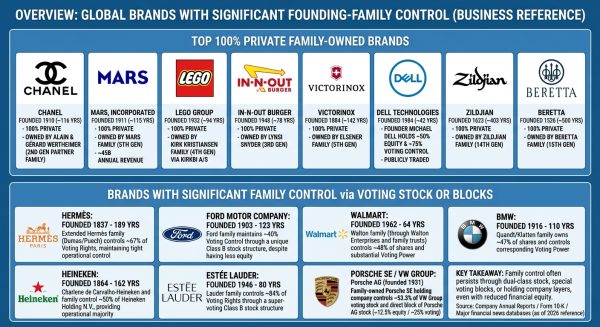
Looking at global family enterprises reveals that unlocking enterprise value isn’t a one-size-fits-all model.
It sits along a spectrum of governance and leadership choices:
- Shareholding Only (e.g., Mars, Inc.): Retaining 100% private equity ownership while delegating executive and operational management entirely to professional stewards.
- Board & Chairman Governance (e.g., LEGO Group): Thomas Kirk Kristiansen serves as Chairman of the Board, stepping out of daily execution to lead long-term strategy, culture, and capital allocation.
- Active Executive Leadership (e.g., Beretta): Franco and Pietro Gussalli Beretta serve directly as Executive Chairmen and Presidents across the holding and operating companies, proving that active leadership can preserve competitive advantage across centuries. This company has a history of 15 generations. If it works well, it just does.
These are just three snapshots across a vast landscape.
Other major global brands like Porsche, BMW, Chanel, Hermès, and Walmart utilize distinct variations of voting blocks, dual-class shares, supervisory boards, and holding structures.
Whether you choose to lead from the corner office, guide from the board chair, or hold strictly from the equity ledger depends entirely on your personal life goals and the season of leadership you are in.
There is no universally “right” path – only options.
Section 1: The Binary Myth
Conventional business culture frames a total sale as the ultimate victory lap.
We celebrate the pitch deck, the valuation round, and the press release announcing a buyout.
But forcing every founder toward a binary choice – either grind forever or liquidate entirely – ignores the vast middle ground where true, enduring wealth is created.
Choosing your destination requires an honest audit of your real life goals.
Do you actually want to part ways with the company you built, or are you simply exhausted by the specific role you currently hold inside it?
Deciding on this strategy is the foundational lever.
Everything else – your organizational structure, leadership recruitment, governance framework, and tax design – flows directly from this single clarity.
This is precisely where high-level executive sound boarding adds immense value.
Before altering equity structures or making irreversible structural moves, founders often need an objective peer to map out their actual lifestyle requirements, test their assumptions, and align their personal aspirations with the optimal business model.
Once you know the life you want to live, we design the corporate vehicle to support it.
Section 2: The Three Hidden Costs of a Full Exit
While a major M&A deal looks lucrative on paper, a complete sale introduces significant friction that many entrepreneurs fail to anticipate during the excitement of a deal room.
Three major costs stand out:
1. The Cost of Capital & Tax Friction
Liquidating an enterprise creates an immediate capital gains tax event.
Once taxes are settled, you face deployment risk.
Taking capital out of a high-margin, cash-generative asset you understand intimately – and reallocating it into unfamiliar public markets or lower-yield instruments – often results in lower net returns than simply holding your original asset.
2. The Loss of Personal Mental Space & Identity
For a dedicated founder, a business is rarely just a balance sheet; it is a primary vehicle for problem-solving, creative expression, and community identity.
A total exit frequently creates a sudden, deep existential vacuum.
Without a deliberate strategy for your mental bandwidth and purpose, post-sale freedom often turns into aimlessness.
3. The Risk of the “Wrong Next Move”
Driven by liquidity and a desire to stay active, former founders often jump prematurely into new ventures outside their core competency.
Harvard Business School research highlights that while serial entrepreneurs with a track record of success hold a higher chance of succeeding in subsequent ventures, the overall failure rate for new business attempts remains high.
Reinvesting proceeds from a proven asset into an unproven venture exposes your life’s work to unnecessary downside risk.
These costs do not mean you should never sell.
They simply mean a full liquidation requires rigorous planning rather than acting as a default escape hatch from operational burnout.
Section 3: The “Third Path” – Building the Yield Engine
If you realize that you still love your brand, trust its market positioning, and want to retain its financial upside, but need a fundamentally different daily role – you are ready for the Third Path: Turning your operating business into a self-sustaining yield engine.
Building this blueprint requires shifting your personal identity from operational firefighter to architect.
The brand models highlighted earlier demonstrate that your new role can be whatever you design it to be.
However, transitioning into any of these roles requires filling specific organizational gaps:
                  [ FOUNDER / ARCHITECT ]
                             │
     ┌───────────────────────┼───────────────────────┐
     ▼                       ▼                       ▼
[ Operational ]       [ Governance ]        [ Capital Allocation ]
Professional CEO &    Board Cadence &       Dividend Policy &
Executive Team        Independent Directors Reinvestment Strategy
To bridge the gap between where you sit today and your target model, your strategic blueprint must cover three essential elements:
- Executive Operational Ownership: Appointing or elevating leadership that holds direct accountability for line-item outcomes, operational execution, and daily problem-solving.
- Governance Frameworks: Establishing a formal board cadence, clear reporting structures, and explicit boundaries for what requires your sign-off versus what stays with executive management.
- Capital Allocation Rules: Defining explicit guidelines for how free cash flow is distributed as owner dividends, retained for enterprise reserves, or reinvested into strategic expansion.
Your job is to identify the operational gaps preventing this transition today and build a systematic plan to close them.
Section 4: The Strategic Readiness Audit
How do you evaluate whether your business can support a shift in leadership or if it will buckle the moment you step back?
Instead of hiding behind dense balance sheet metrics, assess your operational readiness through a practical stress test: The 90-Day Decoupling Test.
Can your enterprise navigate a full 90-day cycle – encompassing sales generation, product or service delivery, client escalation, and financial reporting – without your direct operational intervention?
When founders attempt this, two distinct operational realities usually emerge:
- The Common Pitfall (Single-Point Dependencies): The most frequent point of failure occurs when institutional knowledge, key client relationships, or signature approvals remain trapped entirely inside the founder’s head. When the leader steps out, decision-making stalls and the team defaults to waiting for instructions.
- The Proven Blueprint for Implementation: Companies that transition successfully invest heavily in documented decision-making frameworks rather than rigid procedure manuals. They empower intermediate leaders to make capital and operational mistakes within defined financial boundaries, shifting the culture from “permission-seeking” to “outcome ownership.”
Data from the Harvard Business Review shows that primary enterprise value in middle-market firms is driven largely by the strength and depth of the management team rather than the presence of a charismatic founder.
Building an independent, accountable executive layer is the single most reliable way to de-risk your enterprise and unlock personal optionality.
Section 5: Conclusion & Reflection
Your business should serve your life – not the other way around.
As you consider the next season of your company, pause to reflect on why you started this journey in the first place.
What is the core legacy you want to preserve?
What part of the work brings you genuine energy, and what parts are you continuing to do simply out of habit or central control?
It is equally vital to remember that building an enduring enterprise does not mean forcing your family or heirs to step into operational roles if their personal life choices lie elsewhere.
Many generational business failures stem from pressuring children to manage companies they have no passion to run.
True governance freedom allows family members to pursue their individual paths while the business is stewarded by capable professional management.
Unlocking value is an intentional design process.
Whether you choose to step into the Boardroom, remain active at the operational helm, or sit strictly as an equity holder, the ultimate goal of entrepreneurship is sovereignty over your time and your work.
If you stepped away for 90 days tomorrow, which single operational bottleneck would fail first?
Most founders will read this, agree with the theory, and go right back to putting out fires.
If you’re the exception—and you’ve got the guts to execute a real decoupling audit – reach out.
Drop me a direct message, and let’s talk strategy.”