
Business Strategy Mistakes: How to Know When Your Strategy Is Outdated
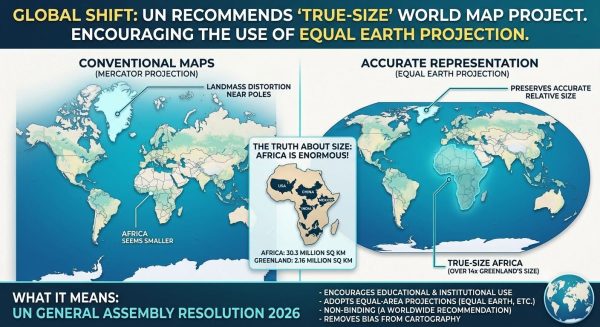
On September 4, 2026, the United Nations General Assembly took an unusual step: it voted to encourage a more accurate way of representing the relative size of the world’s continents.
The resolution, A/80/L.104, titled “Correct the Map: Rebalancing global cartographic representation and promoting equitable representation of the world’s regions, particularly Africa,” passed by 164 votes to 1, with six abstentions. It encourages the use of the Equal Earth projection and other equal-area projections where representing relative size matters.
At first glance, this sounds like a story about maps.
It isn’t.
It is a story about what happens when we mistake a useful tool for an accurate picture of reality.
And that problem exists in almost every boardroom – and in the lives of many of the people sitting around the table.
The Map Wasn’t Wrong. We Were Using It for the Wrong Job.
In 1569, Flemish cartographer Gerardus Mercator created the projection that bears his name.
Mercator wasn’t trying to create a perfectly proportioned picture of the planet.
He was solving a specific problem.
For navigators, the projection had an enormous practical advantage: lines of constant compass bearing – rhumb lines – could be plotted as straight lines.
For its intended purpose, it was an extraordinarily useful tool.
The problem came later.
We began using that specialized navigational tool as though it were a universal representation of the world.
And that is where distortion becomes dangerous.
Mercator dramatically enlarges areas as they approach the poles.
The most famous example is Greenland.
On a familiar Mercator-style world map, Greenland can appear roughly comparable in size to Africa.
In reality, Africa is about 14 times larger than Greenland.
Africa covers roughly 30.4 million square kilometres; Greenland is roughly 2.2 million.
The important point isn’t that Mercator “lied.”
It didn’t.
It optimized for something other than area.
And that distinction matters enormously.
Because we do exactly the same thing in business.
The Real Question Isn’t Why We Built the Old Map
Nobody should criticize Mercator for failing to solve a problem he wasn’t trying to solve.
The more interesting question is:
Why do we keep using maps after the terrain has changed?
A founder builds a company with a particular set of assumptions.
Certain metrics matter.
Certain people make every decision.
Certain customers pay the bills.
Certain sacrifices are necessary.
Certain behaviours keep the company alive.
And then the company changes.
Revenue grows.
The organization becomes more complex.
New markets emerge.
Margins shift.
Capital becomes available.
Governance requirements increase.
The founder becomes a CEO, then perhaps a Chairman, investor or capital allocator.
But the original map often remains.
The same KPIs.
The same reporting structure.
The same definition of success.
The same decision-making habits.
The same founder identity.
The map that once helped the company survive can quietly become the thing preventing it from seeing where it is going.
The Business Mercator: When Legacy Metrics Distort the Enterprise
One of the most dangerous things about an old business framework is that it rarely looks broken.
It looks familiar.
It has historical credibility.
Everyone understands it.
It appears in every board pack.
Someone has been measuring it for ten years.
So nobody asks the most important question:
What problem was this metric originally designed to solve?
1. The Greenland Effect: Legacy Becomes Visually Important
On Mercator, Greenland appears enormous because the projection magnifies its latitude.
Inside an enterprise, legacy can have the same effect.
A mature business line can occupy half the management presentation even though it contributes relatively little to future growth.
A legacy customer can receive disproportionate executive attention because everyone knows the account.
An old product can dominate conversations because its revenue is visible, while a newer, higher-margin opportunity remains buried inside an aggregated reporting category.
Visibility gets mistaken for importance.
Historical scale gets mistaken for future value.
The result is a distorted allocation of executive attention.
2. The Shrinking Opportunity: What Your Reporting System Can’t See
The opposite problem is just as dangerous.
Sometimes the opportunity isn’t actually small.
Your map is making it look small.
A new geographic market may sit inside an “international” line.
A high-margin service may be buried inside “other revenue.”
A new customer segment may be invisible because the CRM was never designed to track it.
An operational improvement may never appear because nobody thought to measure the underlying driver.
The enterprise isn’t necessarily failing to create value.
It may simply lack a measurement system capable of seeing where that value is emerging.
3. The Map Becomes the Territory
This is perhaps the most dangerous distortion.
Eventually, executives stop managing the business and start managing the dashboard.
The metric becomes the objective.
The presentation becomes the reality.
People begin protecting numbers because the numbers are what the organization rewards.
This is the territory described by Goodhart’s Law: when a measure becomes a target, it can stop functioning as a good measure.
A company can therefore become extremely good at improving its scorecard while becoming progressively worse at improving the underlying business.
That is not a measurement problem.
It is a map problem.
The Personal Mercator: When Survival Becomes an Identity
The same phenomenon happens to founders.
And this is where the metaphor becomes more uncomfortable.
In the early stages of building a company, survival often requires extraordinary behaviour.
You work longer than everyone else.
You monitor everything.
You personally solve problems that nobody else can solve.
You obsess over cash.
You sacrifice weekends.
You postpone holidays.
You become the person who always answers the phone.
You learn to operate in permanent urgency.
And sometimes, that map works.
It gets the company from zero to one.
It keeps the business alive.
It creates momentum.
It builds the first team.
It finds product-market fit.
It gets you through the crisis.
The problem isn’t that the survival map was wrong.
The problem is that the company eventually survives.
And the founder keeps using the survival map.
1. The Identity Trap
At some point, the founder can become psychologically attached to being the person who saves the day.
Every problem becomes evidence that they are still needed.
Delegation feels like loss of control.
Governance feels like bureaucracy.
A strong executive team can feel threatening rather than liberating.
The founder says they want scale.
But unconsciously, they keep rebuilding the company around their own indispensability.
The business has evolved.
The identity hasn’t.
2. The Misallocation of Non-Renewable Capital
A business has financial capital.
A founder has something equally important and considerably more finite: time, attention, health and presence.
These are non-renewable forms of capital.
Yet the personal map often allocates them badly.
Work occupies most of the visible territory.
Family gets compressed.
Health becomes a maintenance task.
Reflection disappears.
Friendships become optional.
Stillness becomes something you earn after the next transaction.
But there is always another transaction.
Another raise.
Another acquisition.
Another board meeting.
Another crisis.
Another quarter.
The horizon moves because the map has no destination beyond the next emergency.
3. The Fear of the Uncharted Self
This may be the hardest transition of all.
What happens when you no longer need to be the heroic founder?
Who are you when the company doesn’t require you to solve everything?
What does your life look like when your value isn’t measured by how many fires you can put out?
For some founders, that question is more frightening than failure.
Because the old identity was built under pressure, and pressure made it feel meaningful.
The company can therefore scale while the founder remains psychologically trapped in the startup that no longer exists.
The Map Didn’t Fail. The Terrain Changed.
This is the distinction I increasingly find useful when working with founders, executive teams and boards.
Whether in strategic board reviews and engagements or executive coaching, the challenge is rarely a lack of effort or intelligence.
It is almost always a map problem.
The goal isn’t always to invent a completely new strategy.
Sometimes the more important work is to step back with an independent perspective and determine whether the current strategy is still based on assumptions that remain true.
The same applies to governance.
The same applies to organizational design.
The same applies to executive roles.
And the same applies to the founder’s personal life.
Before building the next three-year strategy, ask a more basic question:
What map are we currently using?
Who designed it?
What problem was it designed to solve?
What assumptions does it contain?
Which of those assumptions remain true?
Which have changed?
And, most importantly:
What important part of the terrain can this map no longer show us?
Six Questions for Your Next Strategic Review
You don’t need a transformation programme to begin.
Start with six questions.
In the Business
- What is our oldest KPI, and what problem was it originally designed to solve?
If the business has changed dramatically since the metric was introduced, ask whether the metric is still measuring what matters. - Where does executive attention go – and where is future enterprise value actually being created?
Look at the allocation of leadership time, not just the allocation of financial capital.
The answer may surprise you. - What important information are we not measuring because the answer might be uncomfortable?
Sometimes the missing metric isn’t missing accidentally.
Sometimes nobody wants to know what it will say.
In Your Life
- Am I operating from a growth map or a survival map?
Survival thinking can be enormously effective during crisis.
It becomes expensive when crisis becomes your permanent operating system. - What part of my life have I allowed to become visually insignificant?
Health?
Family?
Friendships?
Reflection?
Time without an agenda?
Whatever has disappeared from the map may eventually disappear from reality. - What identity am I afraid to outgrow?
Perhaps you’re still trying to be the founder who does everything.
Perhaps you’re still proving something.
Perhaps you equate exhaustion with commitment.
Perhaps being indispensable has become part of your self-worth.
The question isn’t whether that identity helped you get here.
It probably did.
The question is whether it can take you where you’re going next.
The Point Isn’t to Find the Perfect Map
There is no perfect map.
Every cartographic projection makes trade-offs.
Mercator preserves certain properties that make it useful for navigation.
Equal Earth is better suited to showing relative area.
Different maps exist because different purposes require different representations.
That is the lesson.
A map is not good or bad in isolation. It is fit – or unfit – for the job you are asking it to do.
Your company’s original KPI system may have been exactly right for a $2 million business.
It may be completely wrong for a $200 million business.
Your original organizational structure may have been perfect for ten employees.
It may be dysfunctional at 500.
Your founder identity may have been precisely what the company needed in its first five years.
It may become the constraint in the next twenty.
Your survival habits weren’t necessarily mistakes.
They were adaptations.
But adaptations have an expiration date.
Don’t Wait 500 Years
The most dangerous legacy assumptions are not the obviously irrational ones.
They’re the assumptions that used to work.
That’s why they’re so difficult to challenge.
They have history.
They have evidence.
They helped you succeed.
And that makes them harder to let go of than ideas that failed immediately.
The question isn’t whether your current map is wrong.
The question is what it was designed to navigate.
A KPI built to keep a young company alive may be a terrible instrument for governing a mature enterprise.
A founder identity built to survive the first five years may become a prison in the next twenty.
The map didn’t fail.
The terrain changed.
So before committing the next five years of capital, attention and personal energy to the same blueprint, stop for a moment.
Audit the map.
Challenge the assumptions.
Look for the territory it cannot see.
And make sure you’re not spending the next decade navigating a world that no longer exists.
Don’t wait 500 years to correct the perspective.