
How to Protect Your Business from Hidden Climate Risks
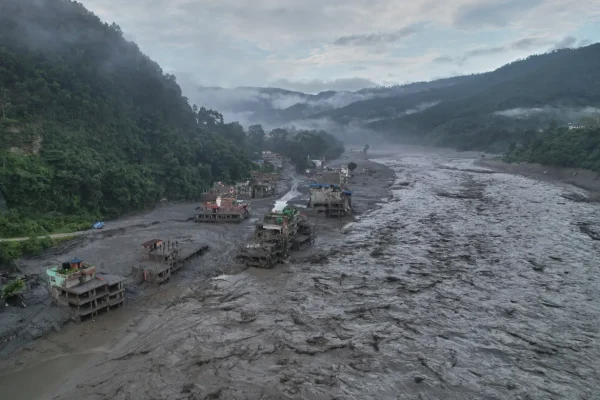
On the morning of 26 August 2026, at 08:37 local time, a high-altitude disaster occurred near the border of Nepal and Tibet.
A 0.2 square kilometer section of glacier at an elevation of over 5,000 meters sheared away from the mountainside and plunged vertically into the valley below.
The kinetic force of millions of tons of ice and rock striking the valley floor released energy equivalent to a magnitude 5.2 seismic event.
That impact melted ice instantaneously through friction, creating a dense surge of water, mud, and boulders traveling at extreme speeds down the Lhende Khola and Trishuli river systems.
Section 1: The Hard Facts of the Disaster
According to official updates from the United Nations Office for the Coordination of Humanitarian Affairs (OCHA) and regional disaster management agencies, over 500 deaths have been confirmed, with more than 1,000 people reported missing across affected districts in Nepal and Tibet.
The surge destroyed houses, hydropower plants, bridges, and critical road networks.
It crippled Gyirong Port – a primary trade land crossing between China and Nepal – effectively cutting off supply lines and isolating vulnerable border communities.
Early news reports and initial government briefings attributed the disaster to an earthquake that supposedly triggered a landslide. Local sensors first picked up a distinct seismic wave, leading authorities to assume a tectonic shift was the root cause.
However, two days later, the US Geological Survey (USGS) revised its assessment.
Satellite imagery from Planet Labs and seismic waveform analysis confirmed that no earthquake had occurred.
The seismic signature was not an external tectonic shock; it was the collapse itself.
The structural failure generated its own seismic wave.
Furthermore, water monitoring stations downstream along the Trishuli River registered water levels rising by up to 9 meters in less than 30 minutes.
The existing early warning infrastructure had been calibrated to track seasonal monsoons and predictable rainfall rises.
It was not designed to detect high-altitude structural degradation taking place in clear weather.
Section 2: Misdiagnosing Internal Failure as External Bad Luck
This pattern – misinterpreting the sudden symptom of an internal failure as an unexpected external shock – is not unique to natural disasters.
In the immediate aftermath of a crisis, human nature looks outward.
When government officials saw seismic waves, their immediate assumption was an external tectonic event.
In the corporate world, founders, CEOs, and executive boards fall into the exact same cognitive trap.
When a company experiences a sudden liquidity crisis, loses a tier-one account, or suffers an operational breakdown, leadership often blames “market headwinds,” “macroeconomic instability,” or “unforeseen industry shifts.”
They treat the event as an external earthquake.
More often, the business was already structurally compromised from within.
What caused the sudden flood collapse in Nepal?
The root cause was not a sudden external strike; it was the slow, unmonitored erosion of structural integrity at high altitude.
The shockwave did not cause the collapse – the collapse created the shockwave.
When an enterprise fails, the market shift or economic downturn is rarely the true cause.
It is merely the catalyst that exposes internal rot built up out of sight over months or years.
When an organization neglects core governance, ignores founder-dependency, tolerates unaddressed shareholder friction, or runs without proper capital reserves, it builds internal friction.
When that structure finally gives way, the resulting fallout looks sudden to outsiders, but it was entirely engineered by internal neglect.
Section 3: Identifying and Auditing 3 Key Operational Blind Spots
To prevent internal collapse, leaders must look beyond standard operational metrics.
Most executive dashboards track surface indicators – monthly revenue, active project pipelines, and broad team activity.
Like river monitoring sensors calibrated only for seasonal monsoons, these metrics often miss high-altitude structural decay.
While every organization carries its own distinct profile of exposure, here are three critical operational blind spots that frequently undermine enterprise resilience:
1. Key-Person Dependency (Structural Chokepoints)
- The Vulnerability: When critical intellectual property, tier-one client relationships, or strategic decision-making remain locked inside the head of a single founder or key executive, the enterprise carries a single point of failure.
- The Reflection: If your core leaders step away from the business for an extended period with zero communication, does the enterprise continue operating smoothly – or does execution stall?
- The Strategic Shift: Moving from individual-led reliance toward a system-driven governance model that institutionalizes knowledge and decouples key roles from daily operational fire-fighting.
2. Vanity Metrics vs. Balance Sheet Permafrost
- The Vulnerability: Top-line revenue growth can easily obscure underlying margin compression, cash-flow lag, or structural debt exposure.
- The Reflection: Does your business rely on continuous top-line momentum to maintain stability, or does your balance sheet carry sufficient liquidity reserves to absorb extended market shocks?
- The Strategic Shift: Treating cash reserves and balance sheet strength not as idle capital, but as the essential permafrost that holds your enterprise together when unexpected friction occurs.
3. Compliance and Governance Debt
- The Vulnerability: Deferring formal shareholder agreements, delaying clear board structures, or leaving equity arrangements informal during early growth stages creates hidden liabilities that compound over time.
- The Reflection: Are your founding documents, shareholder agreements, and corporate governance structures aligned for long-term endurance, or are unresolved ambiguities sitting under the surface?
- The Strategic Shift: Addressing structural governance gaps calmly and proactively, long before external pressure or shareholder transitions force the issue.
Section 4: The Spring Day Reflection (1 September)
Today, 1 September, marks the start of Spring in the Southern Hemisphere.
Culturally, we celebrate Spring as a season of renewal, fresh starts, new initiatives, and bright growth.
But any experienced gardener knows that healthy bloom is not created in the spring – it is determined by the preparation, soil clearing, and root health maintained during the cold months.
A garden cannot bloom if the soil is filled with hidden rot.
Real renewal requires more than launching new projects or setting fresh quarterly targets.
It demands an honest, rigorous inspection of what lies beneath the surface.
Before focusing on new growth this season, clear out the structural liabilities that threaten your enterprise.
Ensure your foundations are built to endure the unexpected.
Ready Your Enterprise for Durable Growth
True governance and key-person decoupling require an objective, independent perspective to surface vulnerabilities before they become crises.
If you are a founder or executive looking to audit structural risks, decouple dependencies, or align shareholder strategy, let’s start a confidential conversation.
Whether exploring a board-level review, founder exit planning, or aligning shareholder strategy for the season ahead, an initial discussion provides an unvarnished space to examine where your hidden friction lies and how to secure your foundation before external pressure forces the issue.