
How to Scale a Business Without Losing Its Value
The real risk of scaling isn’t growing too fast.
It’s losing sight of what made your business valuable in the first place.
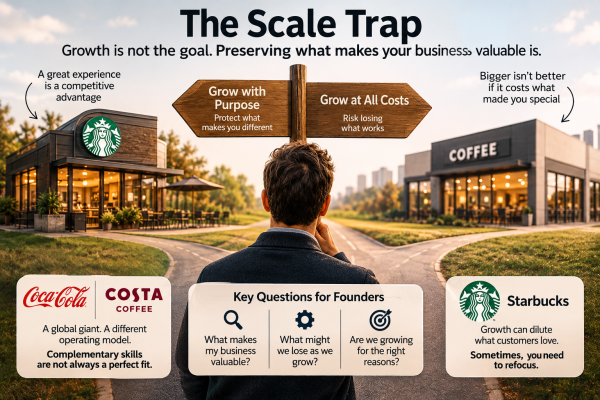
In 2018, Coca-Cola made a $5.1 billion bet on coffee.
It acquired Costa Coffee, a British brand with nearly 4,000 outlets and operations in more than 30 countries. The opportunity seemed clear: combine Costa’s coffee expertise with Coca-Cola’s global reach, marketing power and distribution network.
Coca-Cola had the reach to take Costa much further. But reach alone could not guarantee success.
Selling beverages through a global distribution network is very different from running coffee shops. One depends heavily on moving products efficiently through a supply chain. The other also depends on staff, equipment, service and the experience customers have every time they walk through the door.
The capabilities that made Coca-Cola successful were not automatically the capabilities needed to grow Costa.
That is the strategic question at the heart of any expansion: what makes this business work, and can those same strengths deliver results at a much larger scale?
It is easy to see an opportunity to grow. It is harder to understand what that growth will demand from the business.
When growth changes what customers value
Starbucks offers a different perspective on the same challenge.
The company became a global brand by selling more than coffee.
Customers came for the atmosphere, the baristas and the chance to pause in a welcoming place.
The experience was part of the product.
As Starbucks grew, it faced familiar pressures: serve customers faster, improve efficiency, standardise operations and control costs.
Those are reasonable goals. But a business can become more efficient at delivering its product while becoming less effective at delivering the experience customers value.
In 2007, Starbucks founder Howard Schultz warned that rapid expansion and operational changes were weakening the coffeehouse experience. He was concerned that the company was losing some of the craft and theatre that had made it distinctive.
Nearly two decades later, Starbucks is addressing that challenge again.
Its Back to Starbucks strategy aims to restore warmer, more welcoming coffeehouses, improve service and put the customer experience back at the centre of the business.
In September 2026, Starbucks announced plans to close approximately 250 North American coffeehouses where it could not consistently deliver the experience it wanted or see a path to acceptable financial performance.
At the same time, it continues to invest in its stores and pursue growth.
Starbucks is not abandoning growth. It is working to ensure that what it grows is still worth choosing.
The lesson is not that expansion inevitably damages a business.
It is that growth can quietly weaken the very thing that made it successful.
And the decisions that cause this often look sensible at the time.
A faster process. A leaner team. A standardised service. A lower-cost operation.
Each decision may make sense on its own.
But what happens when those improvements, taken together, weaken the experience customers came for?
The question founders need to ask first
Coca-Cola and Costa show that a successful business model may not transfer easily into a different operating system.
Starbucks shows that even a company with extensive experience at scale can lose sight of what makes its brand distinctive.
For founders, these are not just stories about large corporations.
They are warnings about decisions made at every stage of growth.
Before adding another location, entering a new market, hiring a larger team or investing in expansion, ask:
What, precisely, makes your business valuable – and will those things survive the way you plan to grow it?
The answer may be less obvious than you think.
Customers might choose you because you respond personally.
Your product might stand out because your team takes the time to get the details right.
Your margins might depend on a focused market or a way of working that has never been tested at greater volume.
Some of these strengths can be built into systems.
Others need to evolve.
Some may be difficult to preserve as the business grows.
That is not a reason to avoid change. It is a reason to understand what you are changing before you do it.
Founders often look at demand, cash flow, capacity and market opportunity to decide whether a business is ready to grow. Those measures matter, but they cannot answer everything.
Strong demand does not prove that the business is ready to handle twice as many customers.
A repeatable product does not guarantee a repeatable customer experience.
Healthy margins do not necessarily mean the business can maintain them when the way it operates changes.
The numbers may tell you that you can grow. They may not tell you what growth will cost you.
Think ahead of the problem
By the time customer loyalty weakens, quality slips or margins come under pressure, the decisions behind those problems may be difficult to reverse.
The founder’s advantage is the ability to think ahead – before growth makes the consequences expensive.
Consider three questions.
What breaks first?
If demand doubled tomorrow, what would suffer first: quality, customer experience, team culture or margins?
Where does the business depend on capacity or skills you have not yet built?
What really makes it work?
Which parts of your success come from repeatable systems, and which depend on people going beyond what those systems require?
If your best people left tomorrow, would the business still deliver the same value?
What might you lose?
What do customers value that doesn’t appear in your financial reports?
Could a decision intended to improve efficiency remove something they would miss – even if your internal numbers initially looked better?
These are not exercises in caution.
They are tests of whether the founder understands the business well enough to lead it into its next stage.
The goal is not to preserve everything that worked in the past.
Markets change, customer expectations evolve and successful businesses must adapt.
But there is a difference between changing a business because you understand what it needs next and changing it because the demands of growth are pushing you in that direction.
The first is strategy. The second is reacting.
Bigger is not the strategy
Growth can open new markets, strengthen a business and create opportunities that would otherwise remain out of reach. Sometimes, aggressive expansion is exactly the right move.
But bigger is not automatically better. And growth, by itself, is not a strategy.
The founder’s job is not simply to find the next opportunity.
It is to understand what makes the business valuable, decide what must change to grow, and protect the strengths that give it a reason to exist.
That requires looking beyond the next revenue target and questioning assumptions even when the business is doing well.
Success can make it tempting to repeat what worked without asking whether the conditions that made it work will still exist tomorrow.
The best time to ask these questions is before you scale – not after customers begin to notice what has changed.
So, before setting your next growth target, ask yourself:
Do I understand what makes this business valuable well enough to protect that value at 5x or 10x scale?
Your answers may change how you grow, where you invest or what you decide not to pursue.
That is not a retreat from ambition.
It is ambition guided by understanding.
The real advantage isn’t simply knowing how to grow a business.
It’s knowing what must remain true for that growth to be worth it.